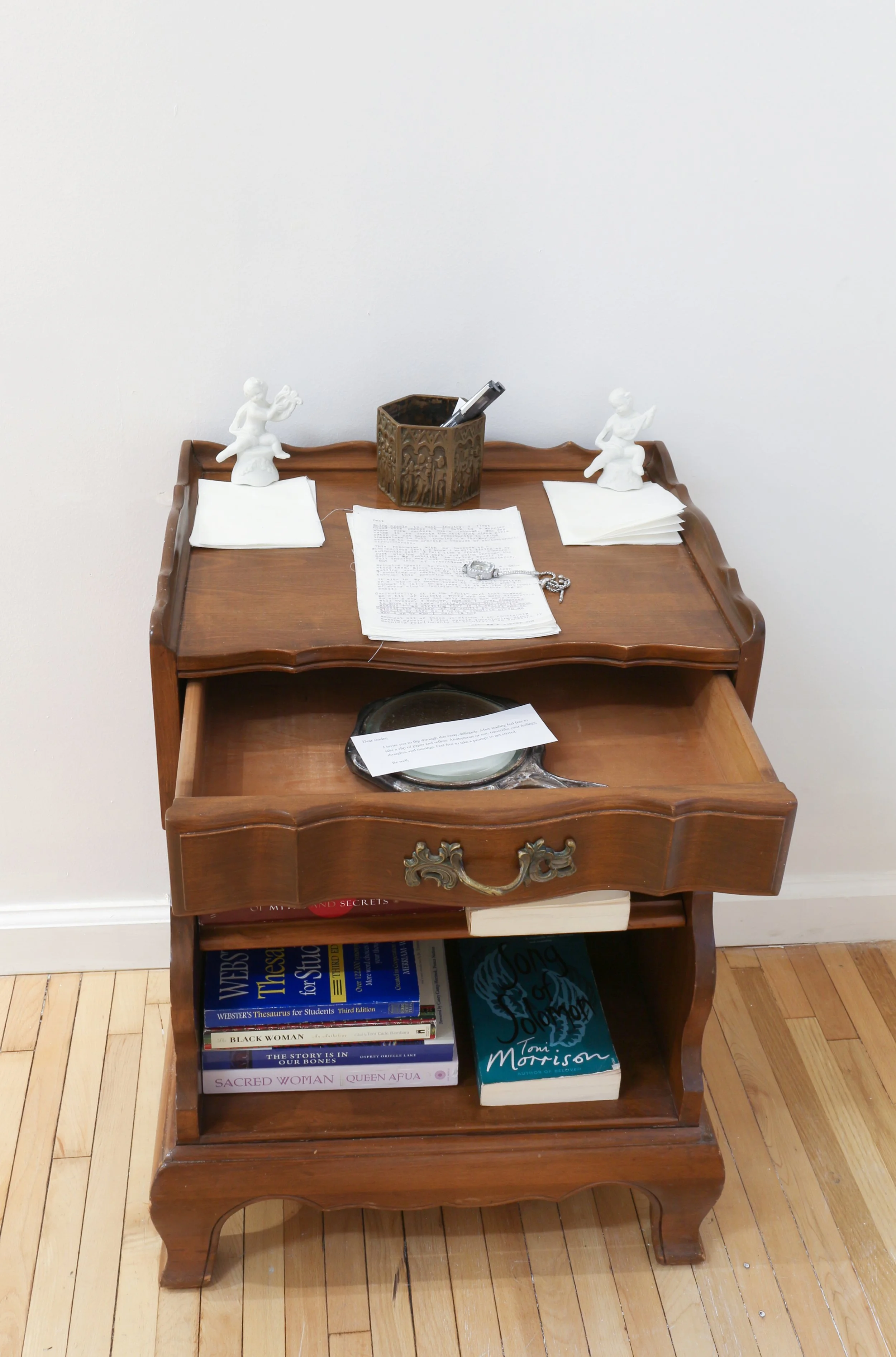
full inquiry, 2026
Original format: typewriter on mulberry paper, nightstand
Exhibition: Slipknots, 2026; June 2 - 21, 2026
Accent Sisters; New York, NY
Dear
Bringing myself to full inquiry. I first heard this phrase at a talk by a scholar whose research centers Black girlhood. She was using it to denote the fact that Black girls often do not have the opportunity to bring themselves to full inquiry because of socio-economic circumstances.
This resonated with me because on a subconscious level, I knew that I wasn’t living as my authentic self. I felt like a fraud, someone just playing the part and going through the motions. My inability to bring myself to full inquiry wasn’t because of circumstance but a lack of intentionality.
Bringing myself to full inquiry…what a daunting task. Since then, this phrase has been guiding verbiage in my life; it is something I consider my north star and godmothers me through this practice I call life.
It sits in my Instagram bio, I have it written on a piece of paper taped to my desk, and I repeat it daily in my head. It is at the forefront of every single decision I make, whether big or small.
Conceptually, it is the “full” part that causes me a bit of anxiety. There are so many dimensions to who I am, and God only knows how many more will evolve. I wonder, How am I ever supposed to know if I have “fully” reached this inquiry status I am striving for? Is it selfish to make myself the center of my orbit? At what age or time in my life do I have a complete grasp on who I am or who I want to be?
Amongst all of these questions I am constantly asking myself, I find myself questioning other people's relationship to inquiry. I am constantly imagining people’s worlds, questioning human ways of doing and existing, wondering what lives people are living and who they are. Are they satisfied with the life they’ve created? Do they feel authentic within their existence? What is something that may be holding them back from exploring themselves? Are they, too, on a journey to full inquiry?
My curiosity about the lives of others has led me to explore my own relationship with consciousness, specifically my phenomenal consciousness. This is a framework that makes sense of our experience in the world and how we see ourselves in it spatially (where), temporally (when), and semantically (what). Not as a noun, but rather a verb, consciousness is a concept that is temporary and ever-changing; it is an understanding of what I know at this moment.
Spatially, I understand myself to be in New York, with ancestral roots in the South and Midwest. I am sitting on my couch in Harlem on the third floor of a pre-war building. My mental spatial state is alright; overall, I am doing well, but my body and mind have been feeling anxious balancing work and my other responsibilities.
Temporally, it is 9:30 PM on a Thursday. It is warm outside, which means that the summer season is nearing, and my body typically begins to feel looser with less stress. A year has passed since I have been in school, which means I have been exploring ways to identify the kind of work that I do unhidden behind an academic institution.
Semantically, I would describe myself as ambiverted, ardent, emotional, introspective, resolved, selective, and a daydreamer. Relationally, my existence is intersectional: I am a Black, queer, educated woman as well as a sister and a daughter (of my family and of the world). Functionally, I am a human who is interested in knowledge transfer by modalities of education, programming, and conversation. I treat my ideas or lines of inquiry as my own personal research projects, I love exploring the gaps or new literature that emerges from my study. I have been trying to figure out the way that my musings can create flesh in this world; how can these ideas manifest into something tangible?
Within this journey to full inquiry, I yearn to explore my “Being.” This is defined as the “whatness” or “nature,” exploring possibilities that transcend my actuality. When I think of “Being,” I think of my favorite cultural theorist, Sylvia Wynter:
It’s the idea of poesis, again; there is also a poesis
of thought; a new poesis of being human.
Poesis means to “lead something into being” or “the act of making.” I wonder who I can become, what possibilities can I explore, what do I dream of, what ways of being can I manifest for my existence? How can I create something that transcends human understanding as we know it?
One of the biggest questions in my journey to full inquiry is intimacy. Trying to define what this relationship with intimacy looks like for the past few years has led me to consider myself in a more serious way; I have become a more intentional and curious human. I used to think of intimacy solely as sexual, but I now understand it to be something more universal. According to the Cambridge Dictionary, intimacy is defined as: a situation in which you have a close friendship or sexual relationship with someone. When I think of intimacy, however, I do not think of it as a phenomenon reliant on another person, but as a nature that you can experience with yourself. Although it can be sexual, I think that intimacy is rooted in the emotional and spiritual realm.
I believe intimacy to be the ability to “live outside ourselves,” as Audre Lorde expresses in Uses of the Erotic. When we are able to articulate our lives (and by lives I mean goals, words, desires, etc.) based on our own internal “erotic guides,” we become more intimate with ourselves and are able to nurture that relationship. I find joy in the harmonious “concert” that is created from the gathering of familiar and unfamiliar, similar and different souls and thinking practices.
When we live outside ourselves, and by that I mean on external directives only rather than from our internal knowledge and needs, when we live away from those erotic guides from within ourselves, then our lives are limited by external and alien forms, and we conform to the needs of a structure that is not based on human need, let alone an individual's. But when we begin to live from within outward, in touch with the power of the erotic within ourselves, and allowing that power to inform and illuminate our actions upon the world around us, then we begin to be responsible to ourselves in the deepest sense. For as we begin to recognize our deepest feelings, we begin to give up, of necessity, being satisfied with suffering and self-negation, and with the numbness which so often seems like their only alternative in our society. Our acts against oppression become integral with self, motivated and empowered from within…When we look away from the importance of the erotic in the development and sustenance of our power, or when we look away from ourselves as we satisfy our erotic needs in concert with others, we use each other as objects of satisfaction rather than share our joy in the satisfying, rather than make connection with our similarities and our differences. To refuse to be conscious of what we are feeling at any time, however comfortable that might seem, is to deny a large part of the experience and to allow ourselves to be reduced to the pornographic, the abused, and the absurd.
I am awake! from the deep slumber that would ultimately reduce me to the pornographic, the abused, and the absurd; it is a privilege to explore our Being and consciousness, even if it is disquieting. To experience is to learn and unlearn yourself over and over again, to hurt and to heal, honoring the role that the erotic plays in the development of full inquiry.
I have loved learning to be intimate with myself – how do you experience intimacy, devoid of another person? For the longest time, intimacy was only something I associated with romance, but now I understand it to be a concept that is otherworldly, but also something so tactile that we can create on our own.
Is intimacy when I practice yoga naked in the mirror, surrounded by candles, listening to Solange and Bilal’s instrumental version of Cosmic Journey? It is an otherworldly melody that allows me to temporarily enter a portal of solitude and reflection. Is it when I walked in the pouring rain to Exotic Fragrances and sniffed maybe fifty scents until I found four that resonated with how I want to be received? Or maybe intimacy is when I continually push myself to put ink on paper and be still with my thoughts? It’s when I have a pit of anxiety in my stomach but still ask the hard questions, because in the words of Marguerite de Navarre (and more recently, Call Me by Your Name), “Is it better to speak or to die?”
The flower of inquiry is delicate yet worth watching blossom, as the seed you planted is a mystery and you do not yet understand the what/where/why/how of it all. I am curious – one of my musings is the exploration of biophilic practices and understanding ways my body feels connected to the earth and land and water, absent from technology. I crave the raw experience of existence that our ancestors lived before screens; to have your hands in soil is one of the most intimate (in my opinion) ways of being.
I wanted to share the ways in which my blossoming to full inquiry has developed and matured my understanding of intimacy. I wouldn’t call it a routine, but my morning is one of the most intimate and sacred moments of my day. It is slow and allows me to center myself before I go to work. I try to go to the gym or move my body in some way. I recently re-discovered how much I have devalued stretching. My stretching practice is maybe one of the most intimate practices I engage in. It forces me to be slow and patient; I get to stare at my naked body (which I love) and admire how strong I am, but also push myself to be more flexible and exist with my physical being and innate self. This may be one of the moments where I feel most human.
Within the rest of my morning routine, I indulge myself in the privilege of washing and moisturizing my face with my favorite products. I look forward to flossing and brushing my teeth because I get to smile doing what I studied every day at work. I used to view routines as mundane and boring: I believed life should be filled with spontaneity, and every day at random—why would I want to be chained to something? As I have gotten older, I now understand routines to be a grounding practice—something that provides stability amongst a spontaneous social/self life, work schedule, and existence.
I am proud to say that my journey to full inquiry began with old-fashioned pen and paper. It is a privilege to have primary source documentation of the different seasons of my life.
I was eleven when I received my first journal. It was from my mother who gifted it to me and served as our main vehicle of communication when I was frustrated from ages 11-15. I was an extremely angsty pre-teen and teenager who was fully engaged in all things “internet”: Kik, Wattpad, Ask.fm, Tumblr, and Instagram. Verbally articulating my feelings is not something that comes easily to me, especially when frustrated. For years, we passed the journal back and forth under my door whenever I was mad (every day). I begrudgingly tried to articulate my feelings in a way that she could understand; I didn’t realize it at the time, but the journal served as a translator and made me more understanding of not only myself, but perspectives outside of my own. To be able to hear my mother’s thoughts via paper forced me to put myself in her footsteps, honoring a point of view that was much wiser and more mature than mine.
Today, I have two journals: my everyday (don’t let that fool you), and my dream journal. My everyday journal is tried and true. I love the way that my handwriting shifts, loops, curves, and changes shapes as my muscles get tired from transcribing my thoughts. I collaged it in my sophomore year of college with a mixture of magazines I had found around campus and ordered from eBay. This would be what I consider my first true work of art, because it is so personal and specific to me. On the front, I arranged an image of a naked black woman sitting on a blue couch with her arm resting on the frame. She sits with a beautiful antique lamp beside her and a Renaissance-like painting behind her. An image of the European, African, and Asian continents overlaps with sheep found in Scotland and women (I’m not sure from what country) eating on a plate with their hands. On the back of my journal, I have collaged images of flowers, greenery, and hands holding antique jewelry. In the bottom right-hand corner, three women's heads are nestled together – a tribute to my sisters and me. Pasted over all of those images are two words: Making Space. My journal is full of space I made for myself, where I can explore my internal eroticism and document my deepest thoughts, fantasies, desires, and recordings.
My dream journal was purchased in Barcelona while studying abroad. I debated spending the fourteen euros, but ultimately am eternally grateful I did. It mimics a traveler's notebook and is made out of a fuchsia fabric with green borders and a multicolored string to tie it closed. To the touch, it is soft and inviting, a feeling I try to replicate with the words within. In this journal, I write in the most descriptive manner all of my wildest fantasies and dreams as if I am recording the day. This is me fully honoring what I dream of – whether it is about my career, my friendships, my relationships, my family, or whatever is on my mind.
Through this process of sitting with myself in pursuit of full inquiry, I question my understanding of sexuality and my relation to it. How do I feel about sex? How do I engage with and understand my sexuality as a way of being? Is it okay that my relationship with these ideas has shifted throughout the years?
I came out to my parents as bisexual when I was eleven. I remember the overwhelming anxiety that I felt leading up to the moment: would they still love me? What would my grandparents think? Can I still see my friends? I had just had my first kiss in the locker room of summer camp. It was a dare at first, and I was hesitant, but then we kissed. From that moment on, I knew that I wasn’t straight. I had already had inklings, but this peck confirmed it.
“How could you possibly know if you’re bisexual? You’re only eleven.” Fair point, I was really young. The consequence of telling the truth and being vulnerable with my parents were met with denial. I was being denied a part of my existence without the opportunity to “Be.” If I were truly bisexual, in my mother’s words, that would mean no more sleepovers with friends, careful watching over hangouts, and more scrutiny in general. I didn’t want that, and so I recounted my statement, even though I knew in my heart what my truth was.
For years, I identified as a lesbian. It is only recently that I have begun to center myself in relation to sexuality versus with someone else. I have learned that my love interests are not necessarily reliant on gender, but more so on intelligence and personal drive. I can love a deep thinker and a good conversationalist.
My locs are a direct result of this journey and encompass all aforementioned methods of bringing myself to full inquiry, specifically in regard to my “internal erotic guide.” I inquired, what would my hair look like in its most natural state? For years, I was getting knotless braids as a result of “external directives” versus “internal knowledge and needs.” From bleached blonde to a shaved head, my hair has lived multiple lives, as I have. I had placed the scale of how beautiful I felt in synthetic hair and African braiding shops (shoutout Remy and Gina though). For years, I hid behind my hair. It infiltrated how I felt about my weight, how I was perceived, and how I viewed my identity. I had desired locs for years, but was hesitant to fully commit to this process.
I knew that to be or to live my truth, I needed to feel beautiful with just my hair, nothing added. It’s like feeling beautiful with no makeup, or without sucking in your stomach. Similar to every stage of inquiry, every stage of my loc journey has exercised my patience and taught me valuable lessons. Even in the widely proclaimed “ugly phase” (which I don’t believe in), I have loved watching my hair tighten and frizz. When I massage my scalp after spraying my homemade water-oil-aloe vera mixture, especially when I have new growth, I feel so sexy and so myself. My hair is now at a bob length, it complements my high cheekbones and brow structure. I am excited to see the ways my hair evolves as I continue my journey – will I have locs forever? Maybe I will bleach my hair again, who knows.
In the English language, we always say “take it easy.” I grew up hearing my dad constantly use the phrase when talking on the phone with family members and friends, usually in the context of a goodbye. I recently asked him what he meant by “take it easy,” and he said:
Be cool
Relax
Be well
Goodbye
Connotatively, I understand “taking it easy” intrinsically means to slow down and be open to receiving. I believe in the power of urgency; however, I do not think it needs to be at the forefront of our movements, habits, or practices. When we rush, we are not able to get to know ourselves or understand ourselves in a sustainable way. We crave instant gratification and desire to have our goals met with a quickness, and are constantly looking to move on to the next thing. It is not necessarily our fault, our world has surpassed the ways in which we were designed to be one with nature and do things manually.
It has been within this stage of my life, on this journey of bringing myself to full inquiry, that I have enjoyed the most. It has been an emotional labor of love and a bit of ego-death to truly explore my consciousness, Being, and existence. I am so curious about the possibilities of reaching full inquiry status. How liberated will I be, or will I even feel liberated? The seeds of inquiry are precarious to plant and nurture, but it is ultimately worth it.
I began this journey because I did not feel internally aligned with myself. Although I do not believe you can ever bring yourself to “full” inquiry, I encourage you to make yourself the center of your orbit, asking yourself questions because why not? Turn your interests into flesh and disseminate knowledge amongst people. In a world with so many distractions, it’s more necessary than ever to bring intentionality and curiosity to the forefront of your existence. Ascend and try again.
Be well,